"Been here a couple of times now.\n\nErik is phenomenal \ngreat showroom with lots of product to see and hear. He is well educated and experienced in HiFi audio especially analog, turntables, niche speakers, amps, etc.\n\nErik has twice gone above and beyond for me as a customer. Just got my new REL subwoofer set up and it's fabulous.\n\nErik made that happen!\nGo see the store. \nawesome to work with"
Walmart Supercenter
2
11
2600 OH-59, Ravenna
OPEN · 06:00 - 23:00 · +1 330-677-0338
"Was there yesterday at the pharmacy around 5:30pm, the customer service was so poor I vowed to NEVER return! I reported the incident to the store management and corporate. I doubt anything will come of this, but I don't plan to shop there again to know for sure!"
For nuclear-encoded genes, splicing occurs in the nucleus either during or immediately after transcription. For those eukaryotic genes that contain introns, splicing is usually needed to create an mRNA molecule that can be translated into protein.
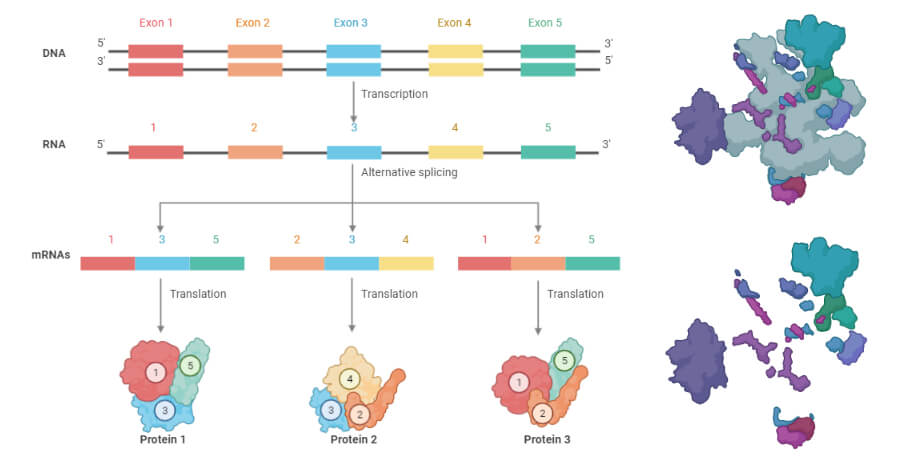
RNA splicing is a form of RNA processing in which a newly made precursor messenger RNA (mRNA) is transformed into a mature RNA by removing the non-coding sequences termed introns.
Splicing occurs during protein synthesis, and involves cutting out and rearranging sections of mRNA. Before mRNA is used as instructions to make a protein, it can be cut into smaller sections and re-arranged in a process called splicing.
What is RNA splicing? In order for mRNA to be translated into a protein, RNA splicing removes the intervening, non-coding sections of genes (introns) from pre-mRNA and links the protein-coding sequences (exons) together.
Most splicing occurs between exons on a single RNA transcript, but occasionally trans-splicing occurs, in which exons on different pre-mRNAs are ligated together.
In this review, we aim to make this mechanism understandable and provide several videos of the spliceosome in action to illustrate the intricate choreography of splicing.
Splicing is a crucial process in molecular biology that involves the removal of non-coding regions (introns) from pre-mRNA and the joining of coding regions (exons) to form mature mRNA.
Explore gene splicing, from its natural role in the human body to advanced engineered techniques transforming medicine, and the ethical questions it raises.
RNA splicing is performed by an RNA/protein macromolecular complex – the spliceosome [8] – that has dozens of protein components essential for the delivery of critical RNA molecules into close proximity with one another at the correct time for RNA splicing [9].
Splicing is the process by which introns are removed and exons are joined together in a pre-mRNA molecule to produce a mature mRNA transcript. This mechanism is crucial for gene expression in eukaryotic cells, as it ensures that only the coding sequences are translated into proteins.